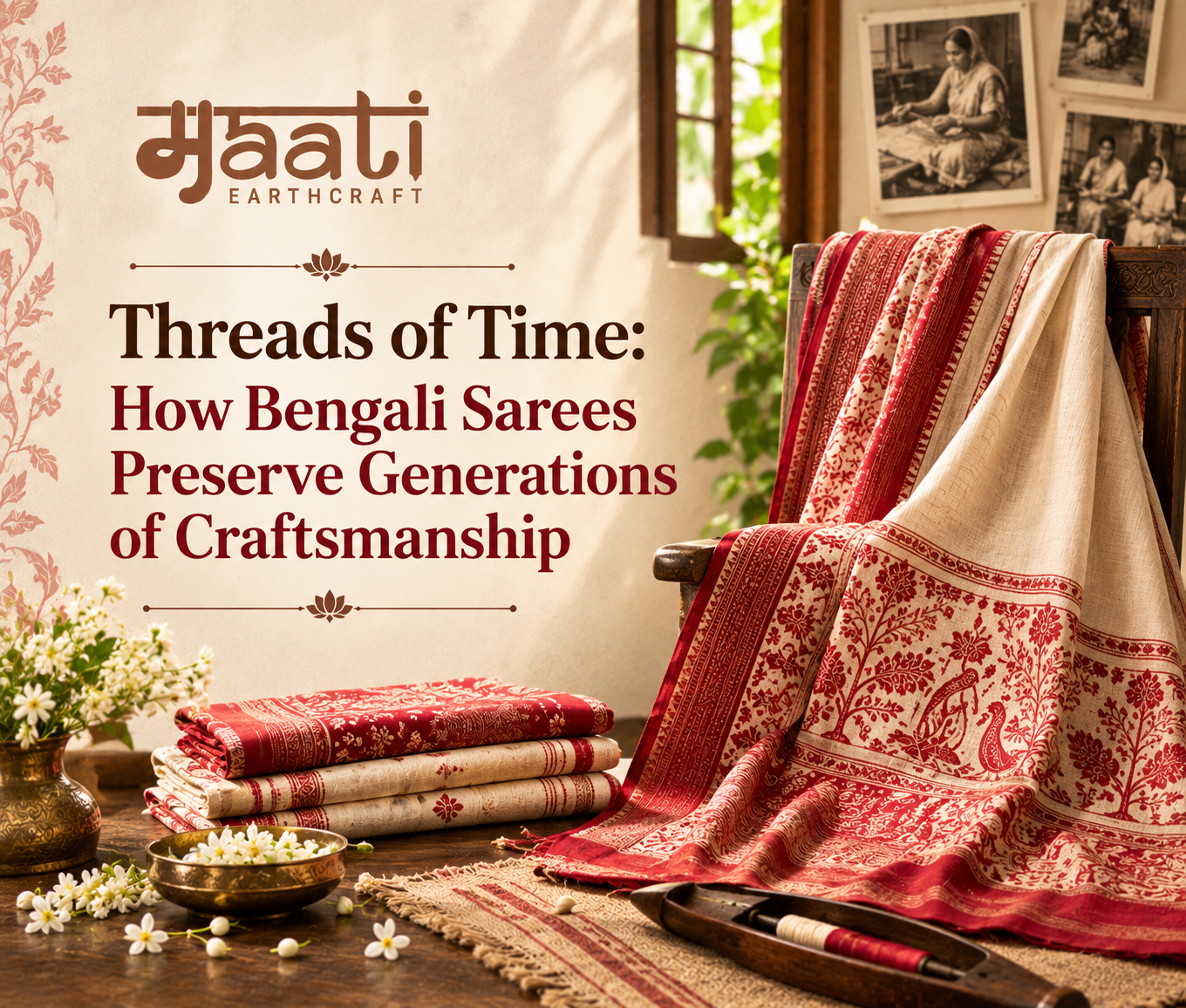
In the quiet villages of Bengal, there is a familiar sound that has echoed through homes and courtyards for generations—the gentle, rhythmic thump-clack, thump-clack of a wooden handloom. It is a sound that speaks of countless hours of dedication, of skilled hands working patiently with threads, and of families whose lives have long been intertwined with the art of weaving. Long before machines took over textile production and fashion became a world of fleeting trends, this humble rhythm was the heartbeat of Bengal’s weaving communities. Even today, it carries the warmth of tradition, the pride of craftsmanship, and the memories of generations who have kept this beautiful art alive.
A Bengali saree is so much more than six yards of fabric. It is a story lovingly woven into threads, a piece of heritage that carries the touch of the hands that created it. Whether it is the soft, breathable comfort of a cotton Tant, the delicate artistry of a Jamdani, the intricate storytelling woven into a Baluchari, or the heartfelt stitches of a Kantha, each saree has a character and a history of its own. Behind every weave lies a craftsperson’s patience, years of practice, and knowledge passed down through families. When a woman drapes a traditional Bengali saree, she wears more than a beautiful garment—she carries a little of Bengal’s soul, its timeless traditions, and the enduring legacy of the people who have lovingly preserved them.
The Loom as a Family Altar
In the weaving heartlands of Shantipur, Phulia, Dhaniakhali, and Bishnupur, weaving is much more than a means of earning a livelihood. It is a way of life; a cherished legacy lovingly passed from one generation to the next. Here, the art of weaving is not simply taught; it is absorbed through years of watching, learning, and working alongside elders. Every thread carries a little of the family’s history, and every woven saree tells a story of patience, perseverance, and pride.
Step inside a traditional weaver’s home, and you will discover that weaving is truly a family affair. While the father carefully arranges the warp on the loom, the mother prepares the yarn, starching and spinning it with practised hands. Children, too, become part of this quiet rhythm, winding bobbins after school and gradually learning the craft that has sustained their family for generations. Together, they breathe life into every saree, each contributing in ways that may never be seen but are deeply felt. Watching an experienced weaver at work is a remarkable sight. With no printed design to guide him, his hands move instinctively, bringing intricate floral motifs and geometric patterns to life through skills shaped by years of practice and knowledge inherited from those who came before him.
For these families, the loom is more than a wooden structure of threads and shuttles. It holds memories of grandparents, the wisdom of parents, and the hopes of children who may one day carry the tradition forward. Its familiar rhythmic sound is woven into the everyday life of the household, connecting the past with the present. In this deeply personal world of craftsmanship, the loom becomes almost a family altar—a place where heritage is kept alive, ancestors are remembered, and love finds expression in every thread.
Poetry Woven on Air: The Magic of Jamdani
There is something truly magical about a Jamdani saree. Delicate, graceful, and almost weightless, it carries within its folds a rich heritage that has survived for centuries. Born from the legendary muslin-weaving traditions of undivided Bengal, Jamdani is an art form so extraordinary that UNESCO has recognised traditional Jamdani weaving as an Intangible Cultural Heritage of Humanity. Often described as poetry woven on fabric, it is a beautiful reminder of a time when craftsmanship was guided not by the ticking of a clock, but by the patience, passion, and imagination of human hands.
Creating a Jamdani is an extraordinary labour of love. Seated at a traditional handloom, the weaver painstakingly brings each delicate motif to life, inserting coloured threads by hand into the fine cotton fabric using small bamboo spindles. Every tiny flower, leaf, and geometric pattern takes shape slowly, thread by thread, often without the help of a printed design. It is a skill that demands remarkable concentration, a keen eye, and an intimate understanding of the craft, nurtured through years of practice. As the weaving progresses, intricate patterns seem to emerge effortlessly, floating like little pieces of art on the sheer surface of the saree. Yet behind this apparent simplicity lie countless hours of dedication and the quiet determination of an artisan who refuses to compromise on perfection.
To hold a genuine Jamdani saree is to experience something far beyond the beauty of a finely woven fabric. It is to appreciate the weeks, sometimes months, of patient work that have gone into its creation. Every motif carries the touch of a weaver’s hands, every thread reflects a moment of careful attention, and every finished saree tells a story of skill lovingly preserved across generations. In a world that is constantly rushing towards faster and easier ways of doing things, Jamdani remains a gentle reminder that some of life’s most beautiful creations cannot be hurried. They must be given time, care, and, above all, a little piece of the human heart.
Myths Woven in Silk: The Epic Tales of Baluchari
If Jamdani is admired for its delicate beauty and feather-light elegance, the Baluchari saree tells a different story—one filled with grandeur, tradition, and the timeless charm of Bengal’s rich cultural heritage. Closely associated with the historic town of Bishnupur, Baluchari silk sarees are much more than exquisite pieces of clothing. They are beautiful canvases on which generations of skilled weavers have brought ancient stories to life. With their richly decorated pallus and intricate designs, these sarees seem to carry whispers of a bygone era, when stories of gods, goddesses, kings, and legendary heroes were passed down from one generation to another.
The making of a Baluchari saree is a remarkable expression of patience, imagination, and artistic skill. Working with lustrous silk and beautifully contrasting threads, artisans carefully weave intricate scenes inspired by the Ramayana, the Mahabharata, and the magnificent terracotta temples of Bengal. Every figure, every decorative border, and every little detail is thoughtfully brought to life on the loom. What makes this tradition so special is the way these weavers transform familiar stories into something that can be seen, touched, and treasured. Their hands do more than weave silk; they keep alive the tales, beliefs, and artistic traditions that have shaped Bengal’s identity for centuries.
For a Bengali bride, draping a Baluchari saree can be an experience filled with emotion and meaning. As the richly woven pallu rests gracefully over her shoulder, she carries with her not just the beauty of silk, but also a part of her cultural roots. Often treasured as family heirlooms, these sarees become witnesses to weddings, celebrations, and precious moments that live on in family memories. In every Baluchari lies a beautiful connection between art and ancestry, reminding us that Bengal’s weavers are not merely creators of fine textiles, but also quiet storytellers who have kept the region’s legends, history, and heritage alive—one thread at a time.
Kantha: The Art of Mending and Making Beautiful
Among Bengal’s many treasured textile traditions, Kantha holds a special place, not just for its delicate embroidery, but for the warmth, love, and memories stitched into every piece. Its story began in the humble homes of rural Bengal, where women found beautiful ways to make the most of what they had. Old, well-worn sarees and soft cotton fabrics, too precious to simply throw away, were carefully layered and held together with rows of simple running stitches. What emerged was more than a quilt or a covering; it was something made with care, often by a mother for her child or a grandmother for her family. In those quiet, thoughtful stitches lay an unspoken expression of love, resourcefulness, and the desire to give something old a new purpose.
Over time, this simple household practice blossomed into one of Bengal’s most cherished forms of embroidery. Picture a sunlit village courtyard, where mothers, daughters, and grandmothers sit together, their hands moving gently across pieces of cloth as conversations, laughter, and everyday stories fill the air. With colourful threads often drawn from the borders of old sarees, they patiently stitched the world around them—flowers blooming in the garden, birds resting on branches, fish swimming in ponds, village scenes, and little moments from daily life. Each design reflected something familiar, something remembered, or something close to the heart. There were no grand workshops or elaborate tools, only skilled hands, creative minds, and stories passed lovingly from one generation to the next.
Today, a beautifully embroidered Kantha saree carries forward that same spirit of simplicity, affection, and quiet creativity. Behind its intricate patterns lies a tradition shaped by generations of women whose artistry often found expression within the walls of their own homes. Every stitch speaks of patience, every motif holds a memory, and every finished piece celebrates the remarkable ability to create beauty from the simplest of things. Kantha reminds us that true craftsmanship is not always born out of luxury or abundance. Sometimes, it begins with an old piece of cloth, a needle, a few strands of thread, and a pair of loving hands determined to turn something ordinary into something worth treasuring for generations.
Why This Craft Matters Today
In an era dominated by mass production, buying and wearing a traditional Bengali handloom saree is an act of quiet rebellion. Every time a weaver completes a saree, they keep a fragile lineage alive against the overwhelming tide of industrial automation.
These garments hold the soul of Bengal—its monsoon-soaked earth, its terracotta temples, its literary soul, and the unyielding dignity of its artisans. When we wear a Bengali handloom, we do not just celebrate a look; we become custodians of a sacred human bridge connecting the past to the future, ensuring that the legendary thump-clack of the loom never fades into silence.