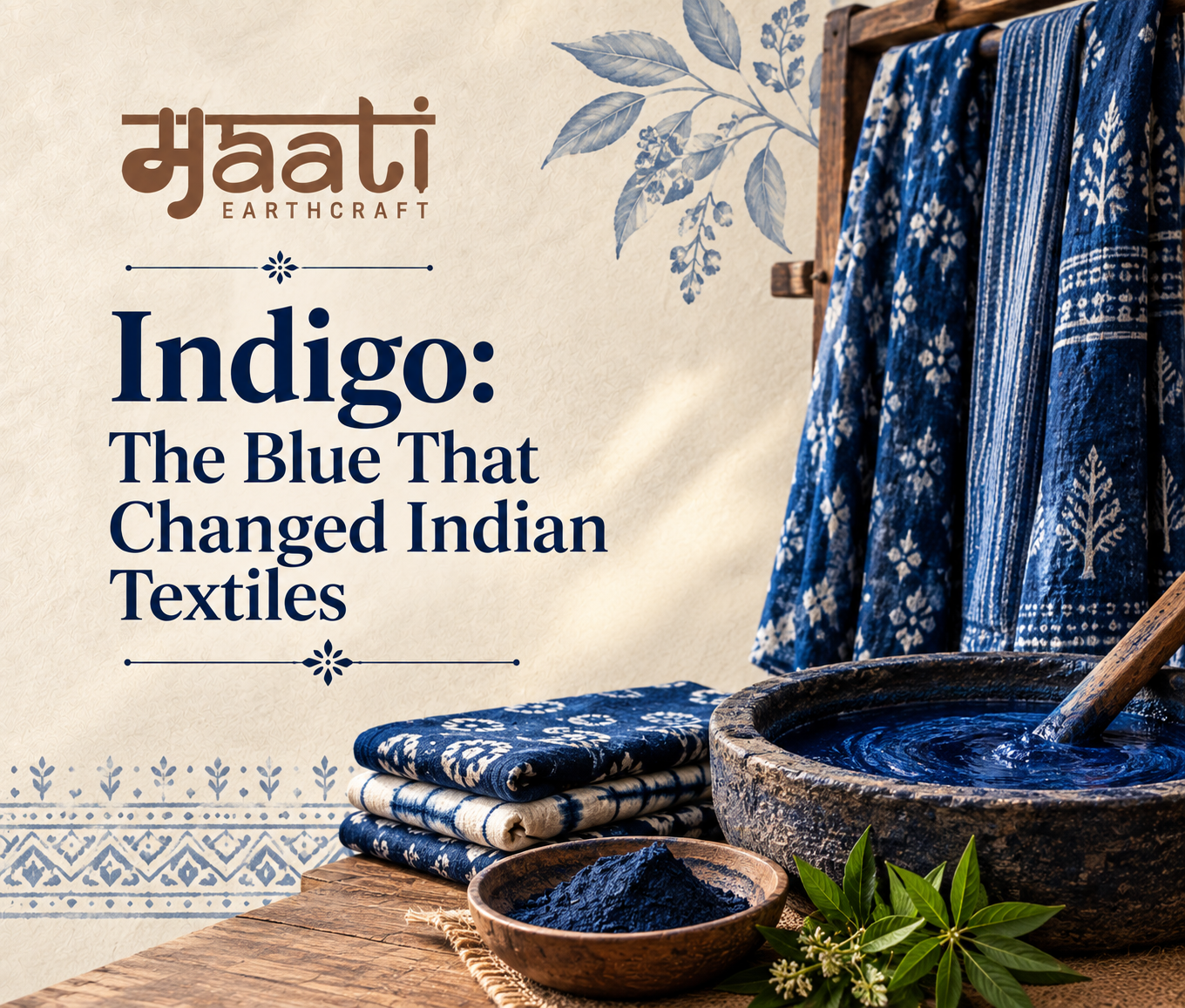
There are colours we choose. And then there are colours that stay with us. Indigo belongs to the second kind.
Deep, almost midnight blue. Sometimes soft as a faded sky, sometimes dark enough to look almost black. It has an unmistakable presence on fabric, a colour that seems to grow richer with time, carrying traces of the hands, the process and the place it came from.
In India, indigo is much more than a shade. It is a story that has travelled through centuries, across regions, communities and crafts. It has coloured sarees, shawls, garments and everyday textiles, becoming part of the visual language of Indian craft.
But the story of indigo is not only beautiful. It is complicated, too.
Indigo begins with a plant. Through a process of fermentation, extraction and dyeing, something seemingly ordinary gives rise to an extraordinary blue.
For generations, Indian textile traditions have worked with natural dyes derived from plants, minerals and other materials. Indigo became particularly distinctive for its depth and versatility. It could transform a plain piece of cotton into something striking without needing elaborate ornamentation.
The Blue Became Part of History
The story of Indigo in India also carries a darker chapter.
During colonial rule, indigo cultivation became deeply tied to European commercial interests. In Bengal, cultivators were pushed into growing indigo under exploitative arrangements, leading to widespread resistance in the late 1850s. The Indigo Revolt became an important episode in the history of colonial India, and its story was later captured in literature, including Dinabandhu Mitra’s Nil Darpan.
It is striking to think that the same colour that appears so serene on a piece of fabric was once at the centre of conflict, exploitation and resistance.
Perhaps this is why Indigo’s story cannot be reduced to aesthetics alone. Its journey through India reminds us that textiles have always been more than things we wear. They have carried livelihoods, identities, stories and sometimes, the history of resistance itself.
Journey of Indigo Vat to Ajrakh Print
Travel west, towards Kutch, and indigo takes on another identity.
Ajrakh, an intricate hand-block printing tradition associated with Kutch and Sindh, is known for its deep indigo, rich red, black and white palette. Its name itself is linked to azrak, the Arabic word for blue. Traditionally created through multiple stages of washing, mordanting, resist printing and dyeing, Ajrakh is a study in patience and precision.
Nothing about an Ajrakh textile happens in a single step.
The cloth is prepared. Blocks are carved and aligned. Resist is applied. Colours are built layer by layer. Indigo enters the process through its own vat, and repeated dyeing helps create the depth that gives Ajrakh its characteristic richness.
The result is more than a print. It is geometric forms, stars, flowers and other motifs meeting one another with remarkable symmetry.
And in the middle of all that complexity, indigo holds the composition together.
Today, Ajrakh has moved beyond traditional garments into sarees, dupattas, stoles, shirts and home textiles, proving that an old craft can continue to find new forms without losing its visual soul.
Indigo and Kantha Stitch Alliance
Now move east, to Bengal. Here, the story changes again.
Kantha is built around the simplest of gestures: the running stitch. Traditionally, layers of old sarees or cloth were brought together and held with rows of hand stitching. Over time, these humble textiles became canvases for flowers, animals, everyday scenes, symbols and stories. The craft remains closely associated with Bengal and is officially recognised as a textile-based craft of the region.
When indigo meets Kantha stitch, two different textile languages begin to speak to each other. The deep blue creates the landscape. The stitches create the movement. One gives the cloth its mood; the other gives it a story.
An indigo Kantha textile can therefore feel simultaneously quiet and expressive. The blue creates a sense of calm, while every line of hand stitching reminds us that someone sat down, thread in hand, and patiently created it.
That is what makes such pieces special. Not just the colour. Not just the stitch. But the time held within them.
A Blue That Keeps Evolving
Perhaps the most remarkable thing about indigo is that it has never belonged to just one era.
It has moved from traditional looms to contemporary wardrobes. From rural craft communities to modern design studios. From sarees and everyday clothing to bags, stoles, home textiles and accessories. Its appeal today is not simply nostalgia. It is the feeling of owning something with a process behind it.
Something where the slight variation in colour is part of the beauty. Where the hand-carved block, the uneven stitch or the changing depth of blue tells us that this was not produced to be identical. It was made. And that distinction matters.
In a world increasingly filled with things designed to look the same, indigo offers something wonderfully different: a colour that changes with the cloth, the dye bath, the hands that make it and the years that pass.
Maybe that is why we keep returning to it. Because Indigo has never really been just blue.
It is the Earth transformed into colour. It is history held in cloth. It is the rhythm of a block, the patience of a stitch and the quiet confidence of something made by hand.
And whether it appears in the precise geometry of an Ajrakh print or the intimate language of Kantha stitch, indigo continues to remind us of one simple truth: Some colours are not merely worn. They are remembered.
At Maati Earthcraft, the story of Indigo finds its way into a collection shaped by craft, colour and the hands behind it. From the intricate geometry of Ajrakh to the intimate, hand-stitched character of Kantha stitch, our collection brings together different textile traditions where indigo takes centre stage. Rooted in traditional techniques yet made for contemporary living, these textiles are a reminder that when colour comes from the earth and craft comes from the hands, every piece carries a story of its own.