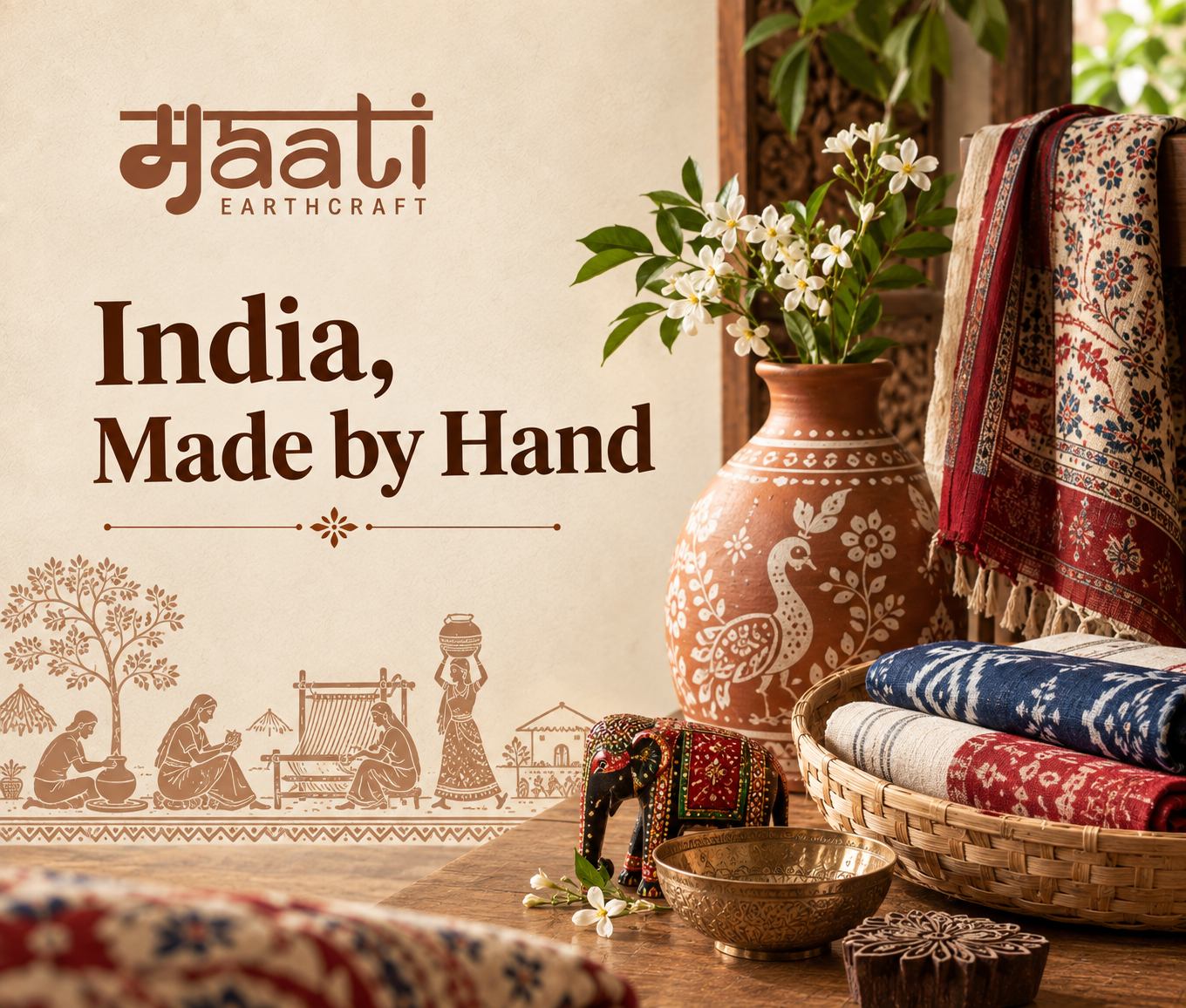
Long before “Made in India” became a label, India was making, by hand, by heart, by heritage.
Ahead of the idea of mass production, generations of Indian artisans were shaping everyday life with their hands, turning clay into vessels, threads into textiles, wood into objects of beauty, and metal into works of intricate detail. Across villages, towns and communities, craft became more than a way of making things. It became a way of preserving stories, traditions and ways of life.
A story moulded into terracotta. A landscape woven into a saree. A folk tale painted on a wall.
India has always known how to tell stories without words.
Perhaps that is why its handicrafts feel different. They do not simply occupy a shelf, adorn a home or become part of a wardrobe. They carry traces of the hands that made them, and the places, people and traditions that shaped those hands.
For centuries, Indian artisans have been turning the ordinary into the extraordinary. A lump of earth becomes pottery. A strand of fibre becomes a textile. A piece of wood becomes a sculpture. Natural dyes become colour. And somewhere between material and imagination, craft becomes culture.
The Country You Can Feel
India is too vast to fit into a single aesthetic. Its crafts are as diverse as its geography.
In Bengal, terracotta carries the warmth of the earth, while kantha transforms layers of old fabric into stories told through needle and thread. In Rajasthan, vivid colours and intricate techniques reflect the exuberance of desert communities. Kashmir turns wood, paper and wool into objects of remarkable delicacy. The Northeast brings the quiet strength of bamboo, cane and indigenous weaving traditions. Across Madhya Pradesh, Odisha, Gujarat, Tamil Nadu and countless other regions, craft traditions emerge from local materials, local landscapes and local ways of life.
Every region leaves its fingerprint. And together, these fingerprints create something larger, the visual and tactile language of India.
A country expressed through colour, craft, material and the touch of human hands.
The Imperfection Is the Signature
Look closely at something handmade. It may not be perfectly symmetrical. A line might wander ever so slightly. Two colours may not be identical. The texture may change from one corner to another.
And that is precisely the point. Machines are designed for consistency. Hands are not. Hands pause. Hands adjust. Hands feel the material. Hands respond to what is in front of them. That small variation is not a flaw. It is evidence. Evidence that someone was there.
In an age of identical objects, handmade craft carries the quiet luxury of individuality. No two pieces are ever entirely the same because no two moments of making are ever the same.
The imperfection is the signature of the maker.
Most traditional crafts do not begin with a manual. They begin with observation.
A child watches a parent weave. A young hand learns to shape clay. A pattern is remembered before it is written down. A technique travels from one generation to another, not merely as a skill, but as a part of identity. This is how craft survives. Not as history frozen in time, but as knowledge passed from hand to hand. And yet, traditions cannot live only in the past. They need new homes, new forms and new audiences.
Today, artisans are bringing traditional techniques into contemporary spaces, creating objects that belong just as naturally in a modern home as they once belonged in a traditional one.
That is when heritage becomes living heritage.
The Story Behind the Story
When we buy a handmade object, we often see the finished piece first.
But there is another story hiding behind it. The hours spent preparing the material. The knowledge built over years. The tools shaped by familiarity. The mistakes corrected by experience. The patience required to begin again.
The final object may be small but the story behind it rarely is. This is why supporting handicrafts is about more than preserving beautiful objects. It is about valuing the knowledge, creativity and livelihoods of the people who keep these traditions alive.
Because when a craft disappears, we do not merely lose a product. We lose a way of knowing the world.
From Soil to Soul
At Maati Earthcraft, this connection lies at the heart of what we believe: craft is not simply about what is made. It is about who makes it, how it is made, and the legacy it carries.
Between Earth and hand. Between tradition and tomorrow. Between the artisan and the person who eventually takes the piece home. Our connection with handicrafts comes from this belief, that something made by hand carries a different kind of energy. It carries time. It carries intention. It carries the memory of a place and the imagination of its maker.
Sometimes, it begins with asking a simple question:
Who made this?
And when the answer is an artisan, a community, a family, a tradition, then the object suddenly means a little more.
And somewhere, in a workshop, a courtyard or a quiet corner of a village, an artisan is still doing what generations before them did: taking something from the Earth and giving it a story.
That is the beauty of Indian handicrafts. They remind us that the oldest stories do not always need to be retold. Sometimes, they simply need to be made again.